
The expensive mistake comes before your first sale
On a first private label product, the biggest payment usually goes out before you make a single sale: the inventory order. Product Validation checks the idea first, against what competitors already sell and what Amazon charges, so you understand the competition and the demand before you invest.
If you're worried about making a mistake because you don't know what you don't know, each checkpoint answers one of those unknowns. Stage 2 tells you whether a new seller can still win in the niche, Stage 3 what Amazon's fees leave you, and Stage 4 whether the market is worth entering. You see the numbers at every step, and the decision stays yours.
Four checkpoints, each with a document
Each checkpoint ends when you need to fetch a file, and the next one starts when you come back with it. Every checkpoint leaves you a document, pass or fail.
Stage 1: five ideas that fit you
You answer one questionnaire about your marketplace, your budget, your supplier and the products you want to avoid. You get a shortlist of five product ideas, each with the search terms to research next, and a Pipeline Tracker workbook that carries your answers through every stage. These are ideas to test. Nothing counts as checked until Stage 2.
Stage 2: do sellers with few reviews already make money there?
For each idea you export the competing products from SellerSprite or Helium 10. The skill checks whether sellers with few reviews already earn real money in that niche, which shows a newcomer can win there, and whether the niche is saturated. The ideas that pass become finalists.
Stage 3: what's left after Amazon's fees
You look up Amazon's fee for a close competitor in Amazon's free Revenue Calculator and send a screenshot. The skill tells you whether the product makes money after Amazon's own fees, and the most it can cost you to make and ship.
Stage 4: the launch verdict
You get a full report on your finalist: market size, demand through the year, prices, what buyers say in reviews, the groups of competitors and the gaps they leave. It ends with a score from 1 to 10 and a verdict, Pursue, Pursue with Angle or Don't Launch, with the reason in one line.
Most ideas stop at Stage 2. Dropping one there costs you an export, far less than finding out after the inventory arrives, and you get a short page with the numbers it failed on and what to try next. Each document carries the Comuteo header and footer.
Where the verdict comes from
A research tool export is a long list of competitors and sales estimates. The skill reads it against fixed checks and gives you a pass or fail, with the numbers behind it.
Every conclusion traces to a file you exported. The skill never estimates a cost, a fee or a freight rate, because the fee comes from Amazon's own calculator, and the verdict follows the market's numbers whatever revenue you hope for. If an input is missing, the skill asks you for it by name, and the report lists anything it couldn't check.
A sample run on my own product idea
I ran Product Validation on an idea of my own: a peanut butter paste for dogs, sold in squeeze pouches.
The pre-screen passed it on 4 of Tomer Rabinovich's 5 checks. Two sellers cleared the first check, one at $16,873 a month with 157 reviews and one at $13,440 with 45 reviews, which is exactly the minimum the test asks for. The report still scored the idea 5 of 10, Pursue with Angle, because one brand holds most of the peanut butter sales and the profit per unit wasn't measured yet.
The report says what it couldn't measure. Stage 3 didn't run on this sample, because I had no Amazon fee lookup or landed cost on record, and the summary page says so. The sales figures are Helium 10's estimates from one export of 70 rows, captured on 9 June 2026, and the report flags the export as short.
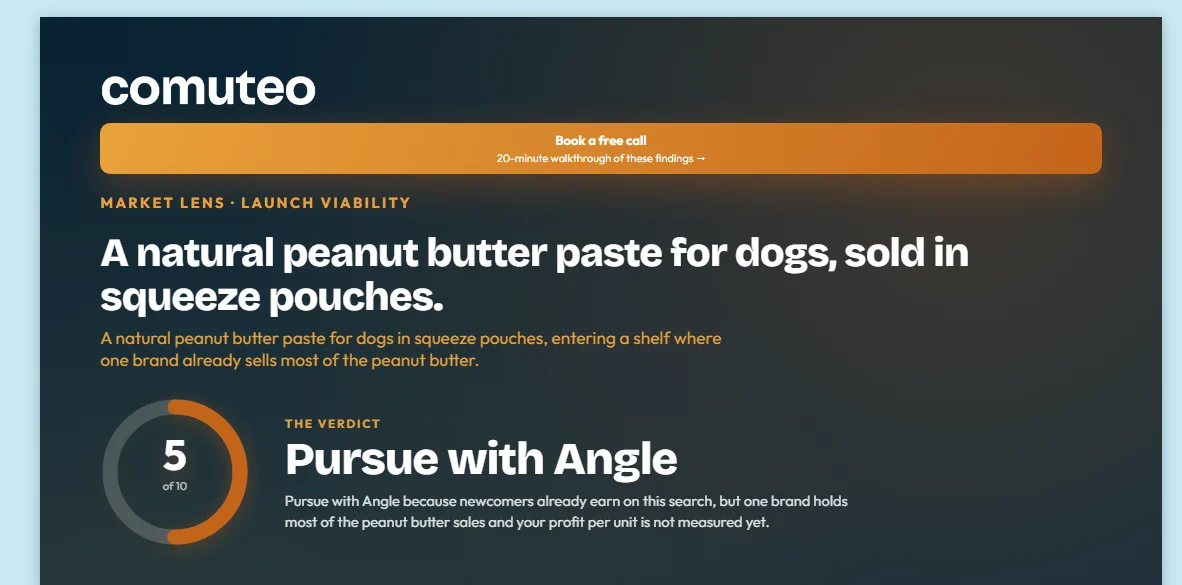
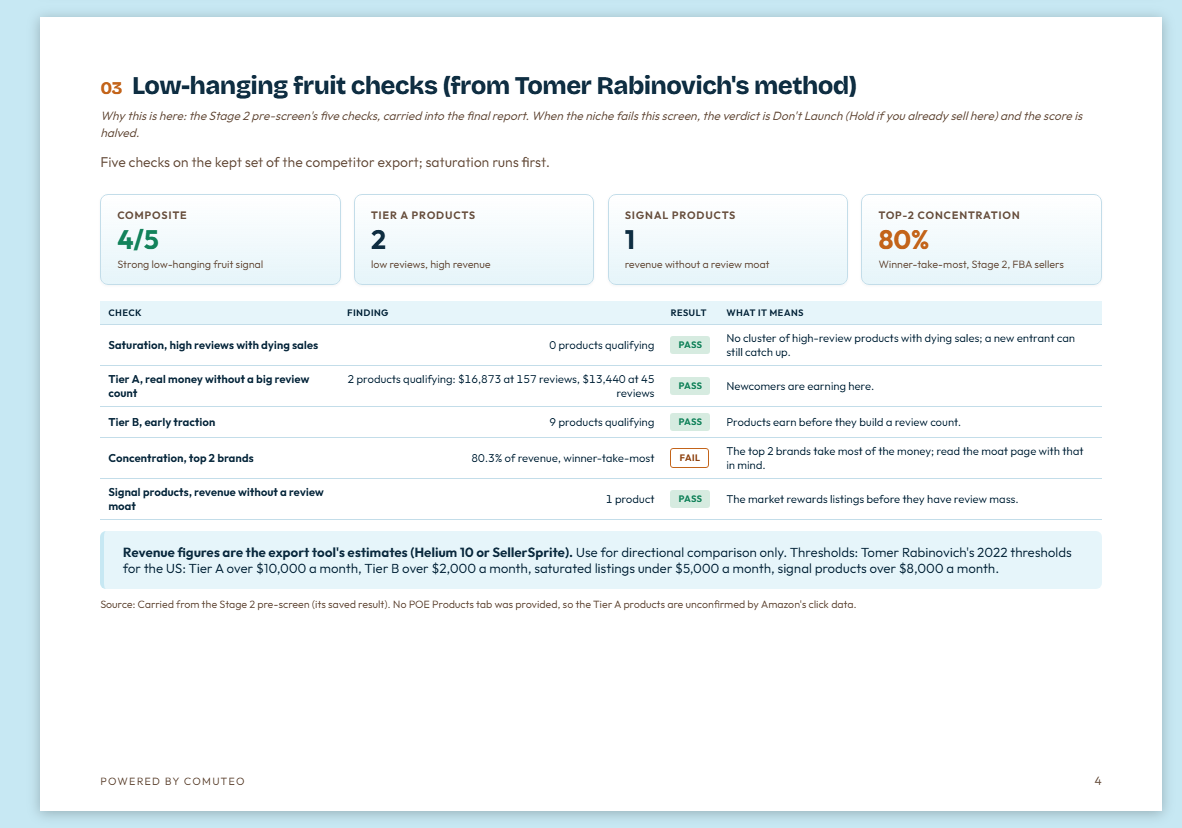
Sample run on my own product idea, 3 October 2026, from competitor data captured on 9 June 2026.
The seller behind the method
Product Validation is built on the product research method of Tomer Rabinovich, author of Ride The Amazon Wave: The Pro Seller's Guide to Private Label Success (2022). Tomer paid for his first private label product with his life savings and launched it in March 2015, and it was quickly doing more than $50,000 a month in sales. He became a seven-figure seller within his first year and built four brands in different categories, and in a 2022 interview he confirmed that his revenue had reached the tens of millions of dollars.
He has since held more than a thousand one-on-one coaching sessions with sellers, and coached one of them from $50,000 a month to $400,000 a month. He founded Top Dog Global, home of the Top Dog Community and the annual Top Dog Summit, and has advised companies that buy Amazon businesses. He has spoken at seller events in Tel Aviv, Guangzhou, London and Las Vegas, and at SellerCon in Austin.
Two ideas from the book's product research chapter run through the skill. Stage 1 follows his Product Tree: start broad, and look for reasons a product could work before looking for reasons to drop it. Stage 2 applies his Low-Hanging Fruit test, which he calls perhaps the most valuable thing a reader will take from the book. It looks for at least two sellers past their launch with fewer than 350 reviews, each earning more than $10,000 a month, and at least two with under 100 reviews already earning more than $2,000 a month. As he explains, sellers like these show that a newcomer can enter the market and start selling quickly. The amounts are his US figures, and the skill scales them to your marketplace, as the book advises for sellers outside the US. He writes that his way of choosing products has worked in his own business and hundreds of times for his students.
Comuteo is not affiliated with Tomer Rabinovich or Top Dog Global, and he has not reviewed or endorsed this skill. The results described above are his own, as he reports them in his book and in interviews. For the full reasoning behind each rule, read the book.
Who built it
I'm Rogerio de Andrade. I spent 30 years developing brands in multinationals, then built my own Amazon private label business past $100,000 in sales. I run this same skill on products for the clients I work with, both to choose a new product and before I recommend dropping one. Nineteen reviews from my Fiverr clients, all about my consulting work, are on the home page.
What you need
- For Stage 1, only your answers. No seller account and no research tool.
- From Stage 2 on, a paid research tool: SellerSprite or Helium 10, either one. SellerSprite's free 3-day trial is enough to start. Helium 10 needs a paid plan, because its free plan limits the Chrome extension the export comes from.
- An Amazon Professional selling account, for the Product Opportunity Explorer, Amazon's own view of a niche. Without one the skill still runs, and the final report drops one confidence level.
- For Stage 3, nothing new. Amazon's Revenue Calculator is free and needs no login in twenty marketplaces, the US and Europe among them.
- Brand Registry is optional. It adds Amazon's Top Search Terms report, which shows when demand peaks during the year.
- The Claude desktop app with Claude Cowork. You don't need to install anything else, and the first section of the SOP, Before You Start, shows you how to add the skill.
How a run goes
- Type /amazon-product-validation in a Claude Cowork chat, or write "find me products to launch". The skill tells you the bar first, then asks its questions in one message.
- Read your shortlist and choose the ideas to test. The shortlist shows exactly how to export the competitor data for Stage 2.
- Bring the exports back and the skill scores each idea. For each finalist it asks for one Amazon file, then names the competitor to look up in the Revenue Calculator.
- Send the calculator screenshot. On a pass you get a guide that lists the files the final report needs, what each one is for and how to get it.
- Bring those files back, and you get the market report with the verdict.
Every file lands in your Downloads folder, one folder per search, each name starting with its stage number, so the files line up stage by stage.
Questions
Can I start without paying for a research tool?
Yes. Stage 1 needs only your answers. You need SellerSprite or Helium 10 from Stage 2 on, and SellerSprite's free 3-day trial is enough to start.
I don't have a seller account yet. Can I still use it?
Yes. Stages 1 and 3 need no account at all. Stage 2 asks for the Product Opportunity Explorer, which needs a Professional selling account. Without one the skill still runs, and the final report drops one confidence level.
What if every idea fails?
Then you found out from a few exports, before any of your money went into inventory. Each failed idea gets a page with the numbers it failed on and what to try next, such as a different search term for the same idea or the next idea on your shortlist.
Will it tell me which product will sell?
No skill can promise that. It tells you whether the numbers in your exports support a launch, and why, and the decision is yours.
Where it fits
Run it before your first product, and again whenever you look for the next one. Stage 1 runs once; Stages 2 to 4 run once for each product you test. After a Pursue verdict and a launch, the SP Bulk Builder sets up your Sponsored Products campaigns in one upload, and the other skills on this page help you run the account from there.
In the download
One zip file. It holds the skill package, which you add once in Claude Cowork (Customize, then Add, then Upload Skill), and the SOP as both PDF and Word. The SOP is the manual: what each stage needs, where to get every file, how to run the skill and how to read the results. Version 6.0.15, updated October 2026.
If it isn't right for you
It's a one-time purchase. If Product Validation isn't right for you, email us within 14 days of buying it and we'll refund the full price. You don't have to give a reason.